Here’s a typical scenario: A $2 billion RIA installs an AI assistant to help advisors respond quicker to client inquiries. Within 30 days, a problem arises when an advisor asks, “What’s the Miller household’s total AUM?” The AI assistant surfaces three different numbers depending on whether it queries the CRM, the portfolio system or the reporting tool.
Three systems. Three versions of the truth. The result? The advisor spends more time reconciling data than they saved using the tool.
Many RIAs are turning to AI tools — 63% use AI in some form, according to Schwab — hoping to free up more time for client-facing work. And time is at a premium for RIAs these days. RIA growth is creating a strain on capacity and service, impeding the ability to scale. But is AI the answer? In practice, many AI strategies fail before they deliver meaningful value.
AI Can’t Produce A Single, Auditable Source Of Truth Without Unified Data
With more than 300 fintech programs across 45 different categories in the market today according to the T3/Inside Information Software Survey, fragmented technology is an ongoing frustration with real implications for RIA firms using AI. Their ecosystems are not platforms. They’re a patchwork and AI can’t reliably reason in such an environment without unified data and a workflow layer beneath it.
This is exactly why the advisor in the Miller household scenario received three household AUM figures. The AI assistant had no authoritative place from which to reason.
As advisory firms rush to adopt AI, many overlook the real foundation of this innovation: unified workflows and data lakes. Without a connected experience across advisors and clients, AI adds complexity instead of value and firms miss a critical opportunity to improve scalability, trust and long-term valuation.
Reality check: Most RIAs aren’t ready for AI. While nearly all firms (94%) are modernizing their data, only 13% have completed substantial modernization work, according to BetaNXT.
Three Core Questions To Gauge AI Readiness For RIAs
For firms looking to use AI to expand capacity across advisors and teams, readiness comes down to whether they can answer these three practical questions consistently.
1. Do you have a single source of truth for each household data point or several?
Can you confidently answer: Who is tied to each household? What assets do they own? What changes have occurred within the household over the past 30 days? If the answer depends on which system (or person) you ask, AI will amplify identity and data quality errors. When AI tools are forced to reconcile conflicting records, they don’t reason; they speculate.
And if a household is like the Miller’s, with information spread across three systems, then the AI has three “truths” to speculate from.
2. Can you view end-to-end workflows through a single source of truth?
Say you need to quickly locate an onboarding or service request. Do you know where to find it? Who owns the next step? What does the service level agreement require? If your workflows aren’t defined and unified, AI will act like another inbox you need to monitor, not true automation. Without unified workflows, AI has nothing to orchestrate.
That’s why the Miller household inquiry stalled; no system owned the next step.
3. Can you produce key firm metrics with clear lineage and permissions?
What does it take for you to pinpoint firmwide AUM, net flows, revenue by segment and which systems contributed to those numbers? When executive dashboards rely on reconciliation by heroics, any AI-generated insight will struggle to earn trust or pass compliance review.
If the Miller household can’t be traced cleanly, firmwide metrics can’t either.
Enterprises Are Struggling To Implement AI Governance
While AI adoption continues to grow, governance is lagging. According to a 2025 survey by AuditBoard and Panterra of 400 governance, risk and compliance professionals, only 25% say they have fully implemented an AI governance program. Even where policies exist, converting them into operational, embedded practices can be a major challenge, whether due to unclear ownership or resource constraints.
Many organizations lack visibility and consistent enforcement, which can be particularly dangerous in the realm of regulated advice.
A Unified Experience Is No Longer Optional
As firms evolve into enterprises and then into platforms, complexity accelerates faster than revenue. As complexity grows, advisors and ops teams are tasked with manually piecing together information from fragmented technology that doesn’t communicate.
This diverts time away from client-facing work. According to Cerulli, advisors only spend 7% of each week on business development, while 83% of RIAs cite limited resources and time as a major or moderate challenge. In the absence of a unified experience, firms are unable to scale without proportional increases in headcount and they can’t defend their data with confidence.
AI Readiness Starts With Data, Not Tools
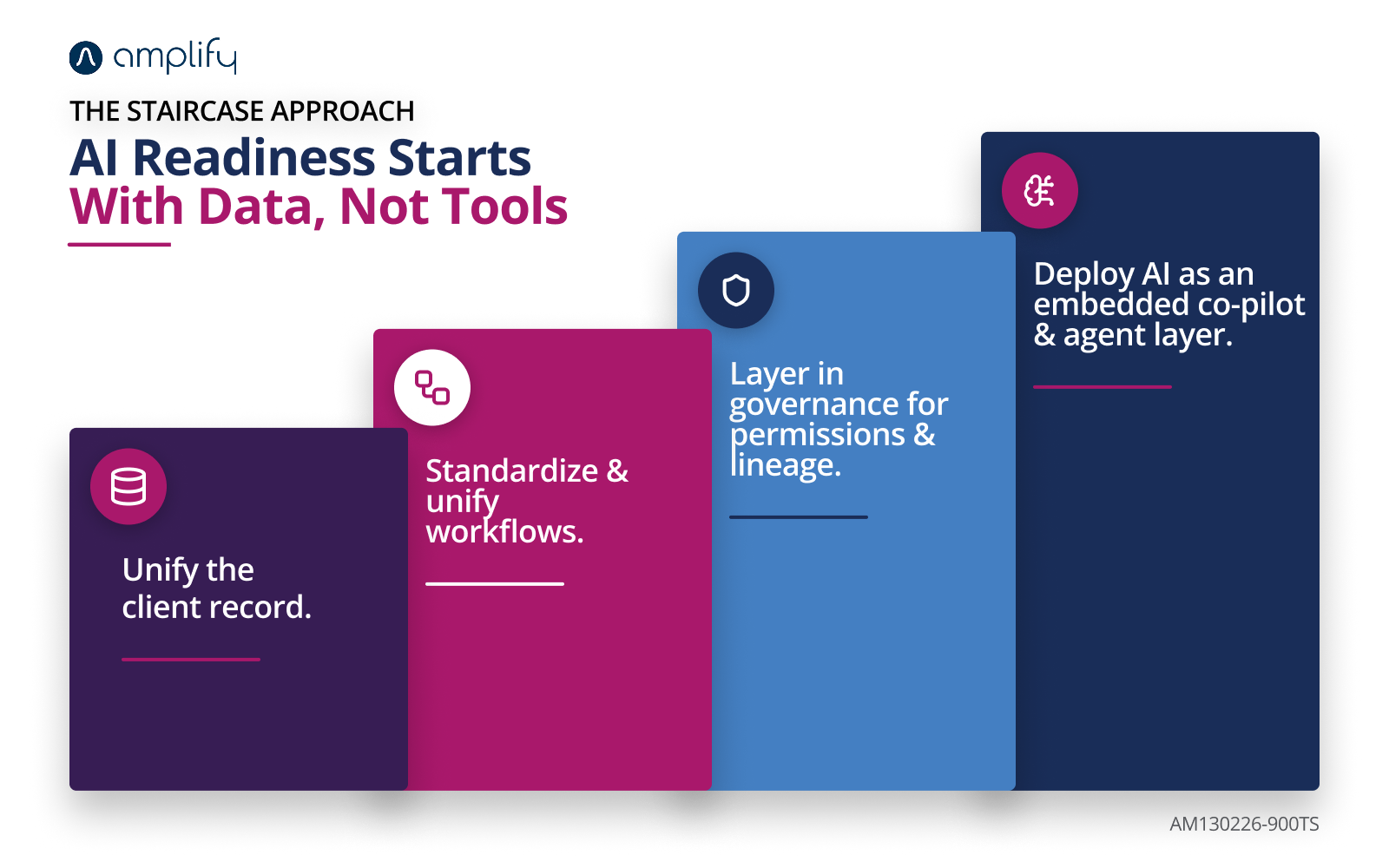
When firm and client data are siloed across different systems — CRM, portfolios, planning software, custodians and reporting — AI doesn’t have a single source of truth to work from, so it guesses. Data needs to be unified first; that’s where data lakes and automation come in. The best path to AI readiness is to approach it like a staircase:
● First step: Unify the client record.
● Second step: Standardize and unify workflows.
● Third step: Layer in governance for permissions and lineage.
● Fourth step: Deploy AI as an embedded co-pilot and agent layer.
When you take the staircase approach, the power of AI compounds. Reverse the order and chaos will ensue.
Valuation Follows Infrastructure
Infrastructure plays a central role in enterprise value by turning growth into scalable margins. It reduces key-person risk, improves auditability and makes firms easier to integrate in transition or M&A scenarios. The same foundation that makes AI effective — unified data, standardized workflows and clear governance — also makes the business more defensible and scalable.
AI has real potential to expand capacity inside RIA firms, but only when deployed on top of that unified operating model. Without a single source of truth, AI doesn’t create leverage; it magnifies cracks that already exist. The firms that will succeed with AI integration are those that first invest in infrastructure.
Churni Bhattacharya is the Chief Product Officer at Amplify.